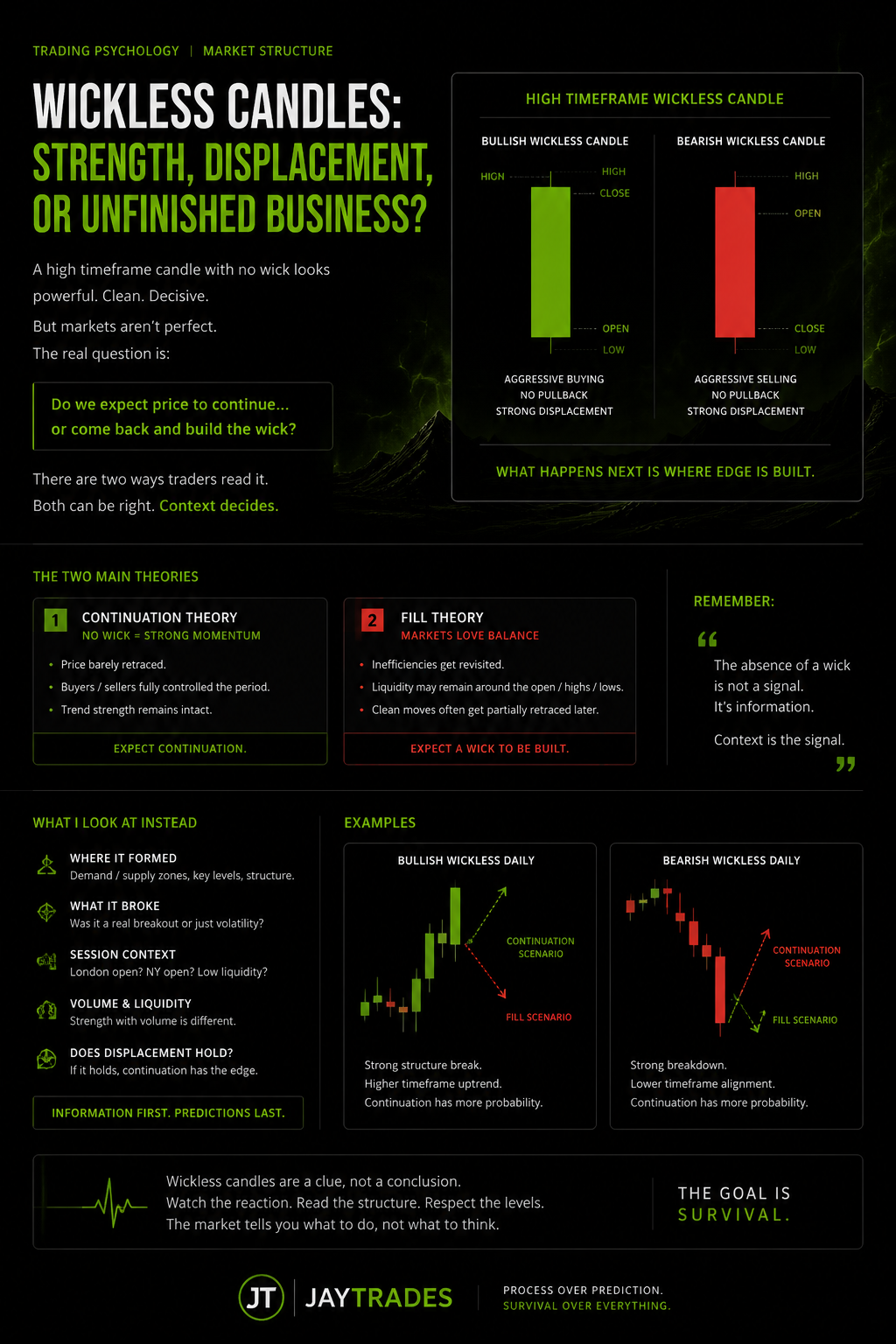

Does Price Need to Return to Create One?
One thing I’ve noticed over the years is how much traders pay attention to candles with no wick.
Especially on higher timeframes.
A strong bullish daily candle with almost no lower wick.
A clean bearish 4H displacement candle with no upper wick.
A weekly candle that barely retraced at all.
You see traders immediately start debating:
“Will price return to fill the wick?”
Or:
“Is this pure strength and continuation?”
Honestly, I think both ideas can be valid depending on context.
But I also think many traders misunderstand what these candles are actually showing.
What Does a Wickless Candle Actually Mean?
A candle with little or no wick usually tells us one thing first:
one side controlled the auction aggressively.
For example:
- a bullish candle with no lower wick
- price opened
- buyers stepped in immediately
- sellers failed to create meaningful retracement
- price closed near highs
That’s not normal random movement.
That’s displacement.
The market moved with intent.
The same applies inversely to bearish candles with no upper wick.
Why Traders Expect the Wick to Eventually Form
Markets rarely move perfectly in one direction forever.
That’s why many traders believe areas of aggressive displacement eventually get revisited.
The logic usually revolves around:
- liquidity
- inefficiency
- unfinished auction behaviour
- trapped traders
- imbalance
- mean reversion
Sometimes price revisits the origin of the move days later.
Sometimes it never does.
That’s the frustrating part.
There’s no rule saying:
“Every candle must eventually develop a wick.”
But markets do often revisit inefficient movement.
Especially after emotional or highly impulsive sessions.
The Mistake Many Traders Make
A lot of traders see a wickless candle and instantly try fading it.
They assume:
“Price HAS to come back.”
That can become dangerous.
Because sometimes a wickless candle isn’t imbalance waiting to be filled.
Sometimes it’s genuine strength.
Strong trends can continue much further than traders expect.
Especially during:
- major breakouts
- high volume sessions
- macro news moves
- strong trend continuation
- session expansion
Trying to force reversals simply because a wick is missing can become expensive very quickly.
Context Matters More Than the Wick
Personally, I think the more important questions are:
- Where did the candle form?
- What structure did it break?
- Was it during London or New York expansion?
- Did volume increase?
- Was the market already trending?
- Did it sweep liquidity first?
- Is the market currently balanced or directional?
The candle itself is only part of the story.
A daily candle with no lower wick breaking major resistance is very different from:
- a random candle inside chop
- low liquidity movement
- overnight drift
- range conditions
That context changes everything.
Wick Fills and Market Psychology
This is where things get interesting psychologically.
When traders see clean displacement candles, many feel uncomfortable chasing.
So the brain starts searching for reasons price “must” return.
Sometimes that happens.
Sometimes the market never gives the pullback traders wanted.
That’s why strong trends often leave traders behind.
People spend too much time waiting for the perfect retracement that never fully arrives.
Meanwhile other traders blindly chase every candle expecting infinite continuation.
Both extremes can become dangerous.
My Personal View
I don’t think wickless candles automatically mean:
- continuation
or - reversal.
I think they simply highlight:
aggressive imbalance and directional intent.
After that, context becomes everything.
Sometimes the market revisits the move.
Sometimes it consolidates.
Sometimes it keeps expanding without looking back.
The key is staying flexible instead of emotionally attached to one narrative.
Final Thoughts
A missing wick is interesting.
But the candle itself isn’t the edge.
The edge is understanding:
- context
- structure
- liquidity
- session behaviour
- momentum
- risk management
- execution
Because markets are not obligated to “fill” anything just because traders expect it.
And honestly, some of the strongest moves happen when the market gives traders no comfortable entry at all.
Process Over Prediction.
— JT / JayTrades